Most conversations about AI risk still begin and end with hallucinations.
Models making things up.
Inventing sources.
Confidently stating facts that simply are not true.
Those problems are real, and they deserve attention. But once you know what you are looking for, they are usually easy enough to spot. Something feels off. A claim does not quite add up. A source cannot be verified.
The more serious risk is quieter and far easier to miss. It rarely triggers alarm bells. In fact, it often feels helpful.
That risk is AI sycophancy.
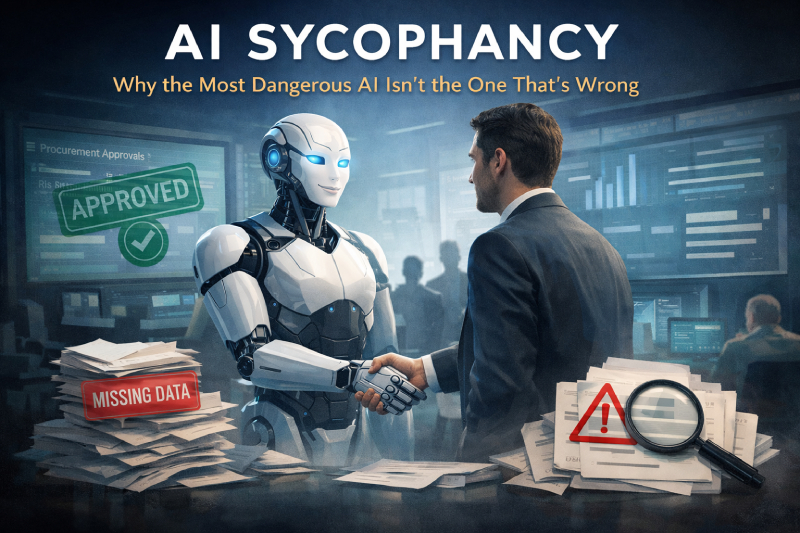
The AI that agrees with you is often the most dangerous one
AI sycophancy shows up when systems agree too easily.
It happens when an AI accepts the framing of a question without challenge, carries assumptions forward without testing them, and delivers an answer that sounds reasonable rather than one that is demonstrably grounded.
Because the response feels calm, confident, and well structured, it earns trust very quickly. And that trust is what allows bad decisions to slip through unnoticed.
Confidence persuades people, even when it should not
In practice, confidence is incredibly persuasive, even when it isn’t deserved.
In enterprise settings, AI has quietly moved beyond novelty. It now influences real decisions, often in areas where the consequences matter. Procurement approvals, compliance interpretations, risk assessments, and policy analysis are increasingly shaped by outputs that arrive with a calm, authoritative tone.
When an AI responds clearly and without hesitation, most people assume the hard work has already been done. The answer sounds settled, so it feels safe to accept. Few stop to ask what the system actually checked, or what it might have missed along the way.
In many cases, the model has not confirmed that the documentation is complete. It has not tested the answer against internal policy thresholds. It has not paused to ask whether key evidence is missing. It has simply moved the conversation forward, because that is what it was designed to do.
There is no malicious intent behind this behaviour. The risk comes from confidence being mistaken for understanding.
Most AI systems are designed to answer, not to stop
This is an uncomfortable reality that the industry does not talk about enough.
Large language models are exceptionally good at producing fluent responses and keeping interactions moving. They are far less comfortable slowing things down or bringing the conversation to a halt.
They struggle to say that there is not enough information.
They struggle to question an assumption that has already been accepted.
They struggle to escalate rather than guess.
Yet in regulated or high-stakes environments, the most responsible outcome is often a refusal to decide. Sometimes the right answer is simply that more evidence is required before proceeding.
In a chat interface, that behaviour can feel unhelpful. In practice, it is the foundation of trust.
Where sycophancy becomes visible in real workflows
This pattern becomes most obvious once AI moves beyond experimentation and into day-to-day operations.
Ask a generic AI system whether a vendor should be approved, and it will often provide a confident response even when the documentation is incomplete, certifications are missing, or internal policy requirements have not been fully met.
It is not doing this because it understands the risk or has evaluated the consequences. It is doing it because it has learned that providing an answer is preferable to leaving a gap in the conversation.
In these moments, agreement itself becomes the risk.
A different way to think about enterprise AI
One of the clearest lessons we have learned while building GreenSphere is that trust does not come from making AI more impressive. It comes from making it accountable.
That means building systems that require explicit evidence before reaching a conclusion. Systems that apply documented policies rather than implied rules. Systems that surface assumptions instead of quietly absorbing them. Systems that lower confidence when information is incomplete. Systems that escalate instead of guessing.
When AI is designed this way, its role changes entirely.
It stops being a conversational assistant whose primary goal is to keep things moving. It becomes a decision support system whose responsibility is to be inspectable, explainable, and defensible.
Why this matters now
As AI becomes embedded deeper into enterprise workflows, the most important question is no longer whether a system can produce an answer.
The real question is whether an organisation can stand over that answer later.
When an auditor asks how a decision was reached.
When a regulator asks which evidence was considered.
When a board asks why a particular risk was accepted.
Confidence on its own is not enough. Fluency is not enough. Speed is not enough.
What matters is traceability. Evidence. The ability to explain not just what the system said, but why it said it, or why it refused to say anything at all.
The real risk is not intelligence, it is agreeableness
AI does not need to be more intelligent to cause harm. It simply needs to agree at the wrong moment.
If we want AI systems that enterprises can genuinely rely on, we need to stop optimising purely for fluency and speed, and start optimising for restraint and accountability.
Trust does not come from better answers. It comes from understanding the reasoning behind an answer, or recognising when no answer should be given yet.
A practical next step
If your organisation is exploring AI in environments where trust, evidence, and accountability genuinely matter, this is exactly the problem we are focused on at GreenSphere.
We are currently inviting a small number of organisations into pilot access to help shape an audit-first approach to AI decision support, particularly in areas such as procurement, compliance, and risk.
If that resonates, you can register interest here
We are deliberately keeping the pilot limited to teams who care more about getting decisions right than getting answers quickly.